How to check a used car: the list from advert to registration
· 10 min read ·
Checking a used car does not start on the seller's driveway. It starts at home, with the registration number from the advert. That saves more than travel: it stops you falling for a car that fails the very first check, and then inventing reasons to wave the red flags through.
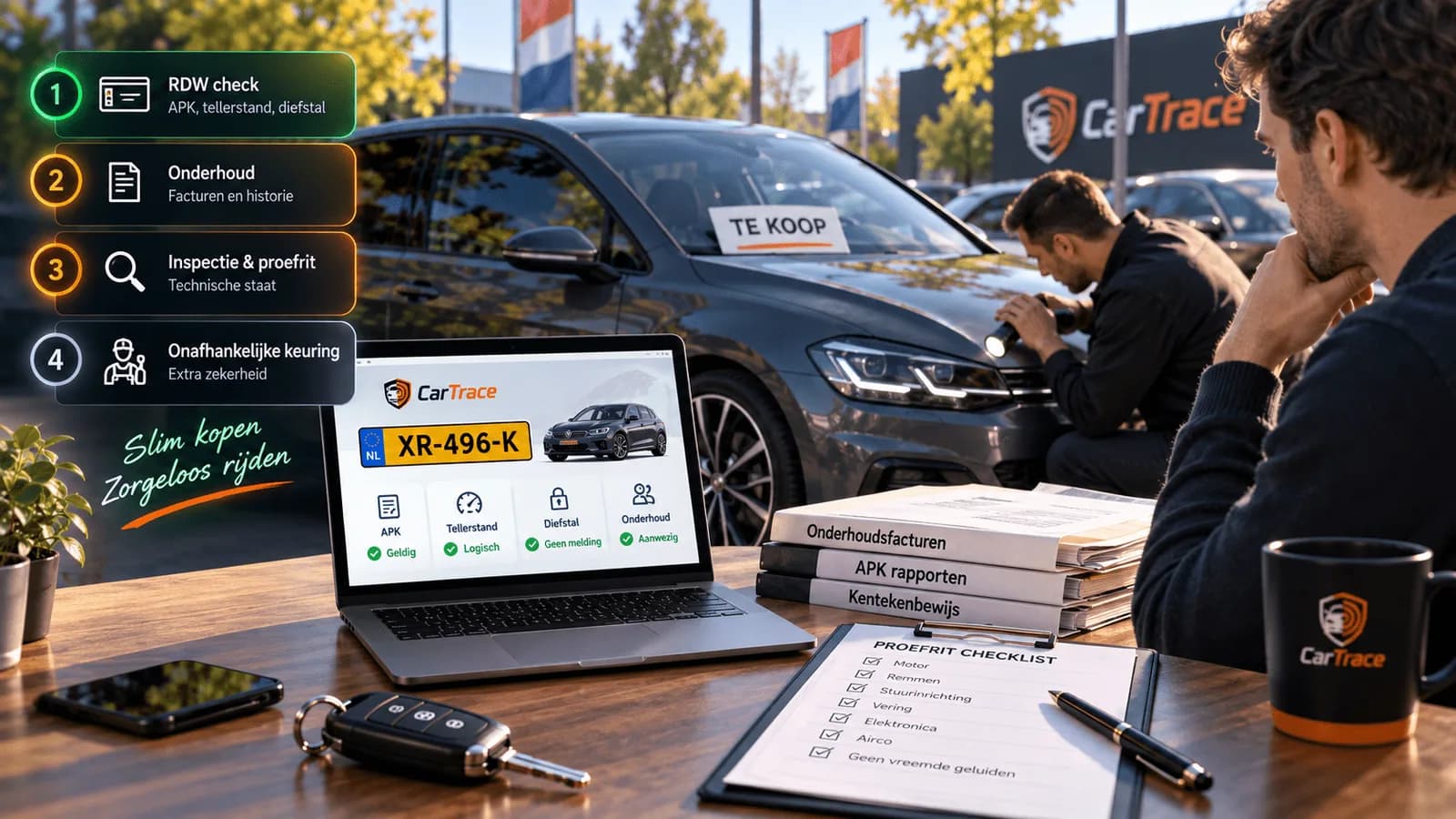
This guide follows the purchase in the order it actually happens: desk work, viewing, test drive, paperwork, money. Whatever fails at step one never has to be driven at step three.
Step 1: the research you do at home
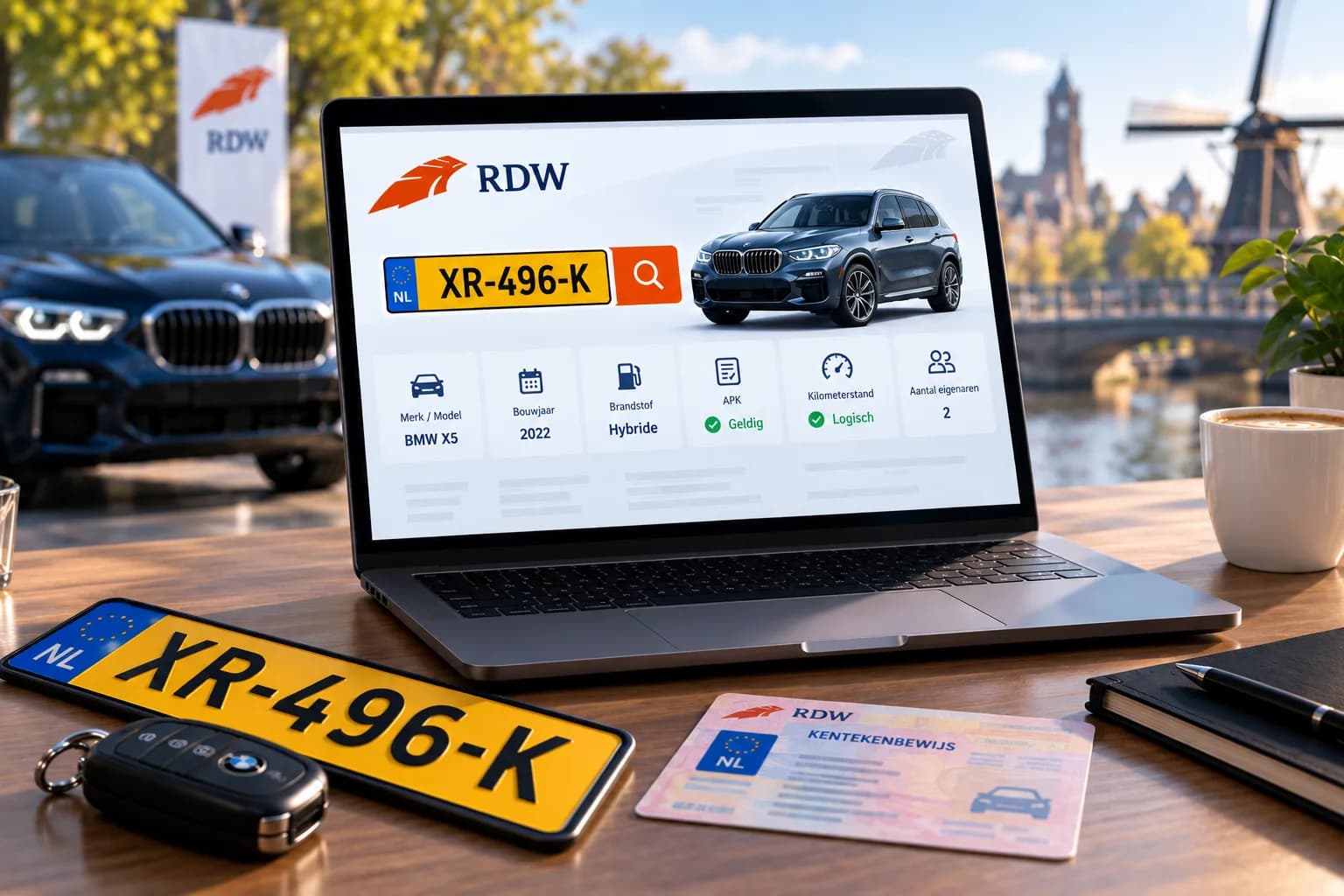
A registration number alone gets you further than most buyers expect. The Dutch vehicle register is largely public, and the fields that matter to a buyer are precisely the ones an advert leaves out:
- APK expiry date. The APK is the Dutch roadworthiness test. If it runs out within a few months, price the test and its likely repairs into your offer.
- WOK status. WOK stands for wachten op keuren, waiting for inspection: after damage or a technical modification the RDW has to approve the car before it may be driven at all.
- Odometer judgement. "Logical" or "illogical", based on every reading recorded at inspections, servicing and transfers of ownership.
- Theft status. Registered as stolen means: do not buy, do not negotiate, end the conversation.
- Recalls. An open recall is not a dealbreaker, but it is something the seller has carried out before delivery.
- Date of first admission versus first Dutch registration. If those differ, the car was imported and Dutch service history is probably missing.
Put the asking price next to that. A valuation tells you whether you are negotiating over a sharp price or over an overpriced car with a discount attached. Our guide to the RDW plate check explains how to read the register data yourself.
Enter the plate from the advert and see APK status, WOK, odometer judgement, recalls, theft status and a value estimate in one view. Free, no account, with a PDF to take with you.
Free plate checkWhat the odometer judgement does and does not prove
This is where buyers most often go wrong. "Logical" does not mean "proven". It means no recorded reading contradicts an earlier one. If no readings were recorded for years, because the car sat abroad or was only ever serviced outside the reporting system, there is simply too little to contradict.
So read the series, not the verdict. A normal car climbs fairly evenly at roughly 10,000 to 15,000 kilometres a year. What you are looking for:
- Are there gaps of several years in the recorded readings?
- Is there one year with strikingly few kilometres, right around a change of owner?
- Do the readings on the service invoices match the ones in the register?
- Does the total fit the wear on the seat, the pedals and the steering wheel?
A wound-back odometer is not rare, and it costs you thousands in value straight away, plus maintenance that arrives sooner than you budgeted. If the picture does not add up, ask for the invoices explicitly. An honest seller has them, or says plainly that they do not.
Step 2: the viewing
Go in daylight, in dry weather, never in the dark under a street lamp. Wet paint in artificial light hides exactly what you came to find. Walk around the car systematically instead of drifting to whatever catches your eye.
Exterior. Sight down the flank at eye level: ripples give away bodywork. Check that panel gaps are even all the way round and that the colour inside the door shuts matches the outer panel. Look for differences in gloss between door and wing, overspray on rubbers, and rust along the bottom of the doors and in the wheel arches.
Identity. Compare the VIN in the windscreen, on the chassis and under the bonnet with the number on the kentekencard, the Dutch registration card. A mismatch, a ground-off plate or a sticker that does not sit flat is reason to stop. Our article on checking whether a car is stolen covers how to take that further.
Underneath. Crouching down is part of the job. Look for rust at weld seams and suspension mounts, fresh underseal covering something up, and traces of oil or coolant. Then push each corner of the car down hard: it should rebound once. If it keeps bouncing, the dampers are finished.
Inside. Test everything with a button: windows, air conditioning on cold, heater, seat heating, navigation, cameras, every door lock. Smell for damp, lift the boot mat and check the spare wheel well is dry. Ask for both keys: having a second key made for a modern car easily runs into the hundreds.
Take your own photos at the viewing: the odometer, the VIN, the type plate and every defect you find. That is your record of what you saw, and it costs five minutes.
Step 3: the test drive
Always drive yourself, however awkward that feels. As a passenger you learn nothing about the clutch and nothing about the brakes. Drive for at least twenty minutes, taking in town, bumps and a stretch of motorway. Start from cold if you can: plenty of faults only announce themselves on a cold start.
- Brakes: brake hard on a straight, empty road. Vibration through the pedal points to warped discs; pulling to one side points to a seized caliper.
- Transmission: does the automatic shift without shunting or hunting? Does the clutch slip when you accelerate in a high gear at low speed?
- Steering: play on a straight road, knocking at full lock, or a wheel that sits off-centre while you drive straight.
- Suspension: clonking over speed bumps, wallowing through a corner, or a car that never settles at a hundred kilometres an hour.
- Engine: blue or white smoke under acceleration, a warning light that only appears after the drive, a coolant temperature that keeps climbing at a standstill.
After the drive, leave the car idling for a minute and check whether anything is dripping where it stood. A car that has just worked for twenty minutes shows you more than a cold one gleaming on the driveway.
The paperwork your signature rests on
The car can be fine and the purchase still be a problem. So always ask for three things, and check them before any money moves:
- The kentekencard, and whether the name on it matches the ID of the person in front of you. If someone is selling "for a friend", ask more questions.
- The last APK report, including the advisories. That list is what the tester saw coming, and it is your negotiating list.
- The service book and loose invoices. Timing belt, clutch and services: what was done, when, and at what mileage?
Buying privately, write down the seller's name and address and photograph their ID or copy the details across. Without that you have no counterparty in a dispute, only a phone number that stops being answered.
When to pay for an independent inspection
A pre-purchase inspection typically costs between one hundred and two hundred and fifty euros and is the cheapest insurance in the whole process. You do not always need one, but in these cases you do:
- The mileage does not line up with the invoices or with the state of the interior.
- You can see signs of repaired damage: overspray, uneven gaps, new parts on an old car.
- It is an import or an ex-lease car with no Dutch service history.
- It is a car with an expensive engine or gearbox, where one repair costs half the purchase price.
The report lists defects with estimated repair costs, which is not only information but negotiating room with a number attached. If a seller refuses an inspection, you have your answer without having to pay for one.
Paying, transferring and insuring
Pay by bank transfer rather than cash, so the payment still exists if the conversation turns unpleasant later. Agree who insures the car at the moment of handover, because an uninsured car in your name is an instant fine.
- Check you are getting both keys, the kentekencard, the transfer code, the service book and the spare key.
- Complete the transfer of ownership at an RDW-approved point, or online if the seller gives you the transfer code.
- Make sure the seller receives the vrijwaringsbewijs, the proof that the car is no longer registered to them.
- Arrange insurance before you drive away, not later that evening.
Buying from a recognised dealer counts as a consumer purchase: the car has to match what you could reasonably expect given its age, price and mileage. In a private sale you do not have that protection. What remains is that the seller must disclose what they know, and you must investigate what you can investigate. Which is exactly why steps one to five exist.
What buyers skip most often
Advert photos are taken at the best moment of the day, from the kindest angle, on a wet car. That is not a lie, but it is a selective truth. The buyer who avoids trouble is usually not the one who knows the most about cars, but the one with a fixed order: plate first, papers second, drive last.
The most expensive mistake with a used car is almost never a mechanical fault. It is falling in love before you have checked.
This article is general information and not legal advice. In a dispute over hidden defects, much depends on the circumstances of your particular purchase. Last checked on 12 September 2026.
Frequently asked questions
›What should you always check on a used car?
At minimum the APK expiry date, the WOK status, the odometer judgement, any open recalls and the theft status through a plate check, and after that the service invoices, the last APK report and a test drive of at least twenty minutes covering brakes, transmission and suspension.
›Where can I check a car for free by registration number?
The RDW publishes the public vehicle data itself through OVI, and the CarTrace plate check puts that same register data together with theft status and a value estimate in one view. Both are free and neither needs an account.
›Does a logical odometer judgement mean the mileage is genuine?
No. "Logical" means no recorded reading contradicts an earlier one. Where there are few recordings, as with an imported car, the verdict says very little. Compare the series of readings against the service invoices and against the wear inside the car.
›Is a pre-purchase inspection worth it?
Where there is doubt, almost always. For roughly one hundred to two hundred and fifty euros you get a list of defects with estimated repair costs, and that list doubles as your negotiating room. Especially for imports, signs of damage repair or an odometer that does not add up.
›What should I watch for with a private seller?
Check that the name on the registration card matches the seller's ID, record their details, pay by bank transfer and arrange the transfer of ownership and the insurance immediately. Consumer-purchase protection does not apply to a private sale.
Check any VIN or licence plate for free.