Used EV asking prices rose more than 5,000 euros this spring. What does that mean for buyers now?
· 7 min read
Quick answer: the average asking price of a used EV on AutoScout24 Netherlands rose from 32,091 euros in March to 37,482 euros in June, after higher fuel prices pushed interest towards electric. In July and August it fell slightly, to 37,048 euros. The market is cooling, not crashing. Buy the car, not the headline.
Anyone looking for a used electric car this spring saw it happen: cars that sat on listing sites for weeks in February were gone within a week in April, and for more money. Now that prices are falling for the first time in months and a new subsidy is on the way, the question for many buyers is: buy now, or wait?
This article lays out the numbers, explains what they do and don't mean, and shows what you should never skip in a fast-moving market.
The numbers: how used EV prices moved
AutoScout24 publishes the average asking price per fuel type every month. For used fully electric cars in the Netherlands, 2026 so far looks like this:
- January: 32,454 euros, down 2.8 percent.
- March: 32,091 euros.
- April: 34,514 euros, up 7.55 percent in a single month.
- May: 36,538 euros, up 5.86 percent.
- June: 37,482 euros, the peak so far.
- July: 37,293 euros, down 0.50 percent: the first fall since March.
- August: 37,048 euros, down 0.66 percent.
For comparison, used petrol cars went the other way over the same period, from 18,710 euros in April to 17,829 euros in August. Hybrids rose slightly, to 38,744 euros in August.
Why used EVs got more expensive so quickly
According to AutoScout24, interest visibly shifted towards electric from early March, while demand for petrol and diesel fell. The trigger is no secret: fuel prices rose sharply this year. In August, AutoScout24 recorded a petrol price of 2.71 euros per litre. If you fill up every week, you quickly work out what charging at home saves.
More buyers chasing a supply that can't grow in a few weeks: prices go up. About 12 percent of all searches on the platform in July were for a used electric car, led by Flevoland (16.1 percent) and trailed by Limburg (9.5 percent).
What the numbers don't say
Two caveats most headlines leave out:
- These are asking prices, not sale prices. What is actually paid after negotiation is usually lower.
- An average also moves with the mix. If more large, expensive EVs are for sale, such as the Skoda Enyaq, Audi Q4 e-tron and BMW iX3 from August's top five, the average rises even if no individual car gets more expensive.
The market was hot, no doubt. But "every EV got 5,000 euros more expensive" isn't true. What a specific car is worth depends on the model, trim, mileage and above all the battery.
Cooling, not crashing
Two months of slight decline after a rise of more than 5,000 euros is not a collapse. AutoScout24 describes the market as "somewhat calmer" after the spring's swings. At the same time, dealer sales in August were 4.8 percent lower than a year earlier.
For buyers, that mainly means: there is room to negotiate again. A car that has been listed for three weeks no longer gets bought from under you within a day. That gives you time to check properly, and you should take it.
A trade-in subsidy is coming: wait if you qualify
The Dutch government is preparing a scrappage scheme (inruilregeling): hand in an old petrol or diesel car with emission class 1 to 4 for scrapping, and get a subsidy towards a used fully electric car. It is aimed at low- and middle-income households and will be run by the RVO, the Netherlands Enterprise Agency.
- When: the intended opening is the fourth quarter of 2026. If the link with the Dutch tax authority isn't ready in time, it moves to the second quarter of 2027.
- How much: press reports mention 4,000 and 6,000 euros, depending on income. Those amounts have not been published as final.
- Budget: about 52 million euros in total, of which only 2 million in 2026. Early applicants have the best chance.
If you qualify, don't rush a purchase before the scheme opens. You probably can't claim the subsidy afterwards. Watch the RVO for the final terms. More on subsidies and the MRB (Dutch road tax) for EVs in our guide to buying a used electric car.
In a hot market, checks get skipped
Fast-rising prices have a side effect: buyers afraid of missing out skip steps. With an electric car, those are the steps that cost the most money. Always do these five, however busy the market:
- Battery health (SoH). The battery makes up a large part of the value. Ask for a recent battery certificate and compare it with what you can expect for that age and use.
- Market value. Is the asking price above what comparable cars fetch? In a market that has just peaked, you otherwise pay the top.
- Theft and register check. Theft status, APK (the Dutch roadworthiness test), recalls, odometer judgement and import history, from the number plate.
- Compare. Put your two or three favourites side by side: price, battery, range, running costs. The difference is often not where you expect it.
- Costs after purchase. The MRB discount for EVs got smaller in 2026, and heavy EVs pay by weight. Count the yearly costs, not just the purchase price.
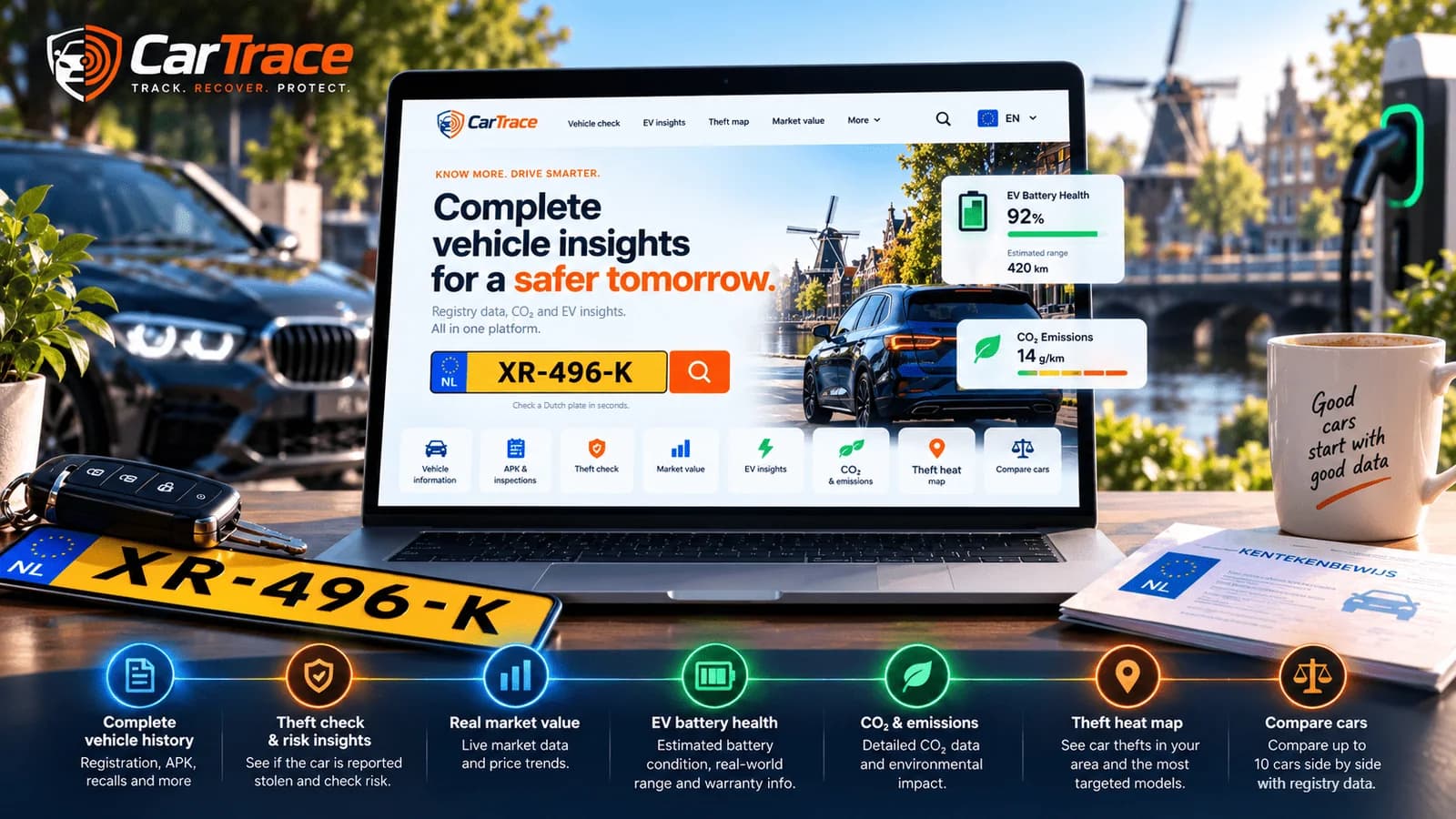
The CarTrace plate check covers the first three in one go: it estimates the battery health to expect and reads in a battery certificate, shows a value estimate, and shows theft status, APK, recalls and mileage. With compare cars you put your shortlist side by side, and the theft map shows where cars are being stolen near you.
Check the battery health, market value, theft status and history of the EV you have your eye on, before you make an offer.
Check a plateUnsure about its technical condition? Have the car inspected and ask specifically for a battery test. How to arrange that is in our guide to the pre-purchase inspection.
Buy now or wait?
Nobody knows where prices will be in three months, and anyone who claims to is selling something. What you can do is apply the question to your own situation:
- Wait if you fall within the trade-in scheme's target group and own an old petrol or diesel car that qualifies.
- Wait if you're in no hurry: the market is cooling, and time is negotiating room.
- Buy if you need a car now, find a good one with a healthy battery and a fair price, and can charge at home. At current fuel prices, every month on petrol adds up too.
- Never buy because the market will "go up again otherwise". That is the thinking that made buyers skip checks in April.
Sources: AutoScout24 Occasion Dashboard, autoscout24.nl/bedrijf/occasion-dashboard (average asking prices, January to August 2026) and Nederland Elektrisch (trade-in scheme, April 2026). The subsidy amounts are not final; check the current terms with the RVO (rvo.nl). Status: 6 October 2026.
Frequently asked questions
›Did used electric cars get more expensive in 2026?
Yes. The average asking price on AutoScout24 Netherlands rose from 32,091 euros in March to 37,482 euros in June, after higher fuel prices shifted interest towards electric. In July and August it fell slightly, to 37,048 euros.
›Will used EV prices fall again?
They have been falling slightly since July, for the first time since March. It is a cooling, not a crash. Where prices go next depends partly on fuel prices and on the trade-in scheme.
›When does the Dutch trade-in subsidy for used EVs open?
The intended opening is the fourth quarter of 2026, with the second quarter of 2027 as the fallback. It will be run by the RVO. The final amounts and terms had not been published as of 6 October 2026.
›How much is the trade-in subsidy?
Press reports mention 4,000 and 6,000 euros, depending on income, for people who scrap a petrol or diesel car with emission class 1 to 4. Those amounts are not final.
›What should I check on a used EV in a hot market?
The battery health (SoH), whether the asking price matches the market value, the theft status and register history, and the yearly costs such as the MRB. Don't skip those checks out of fear of missing the car.
This article was drafted with the help of AI tools, including Leo, and checked and edited by the CarTrace team before publication.
Check any VIN or licence plate for free.
See more of CarTrace on Google
Pick CarTrace as a preferred source and our guides show up more often in your Top Stories and AI answers on Google.
Add CarTrace as a preferred source on Google