Pre-purchase car inspection: what it costs, who does it and what to do with the report
· 9 min read
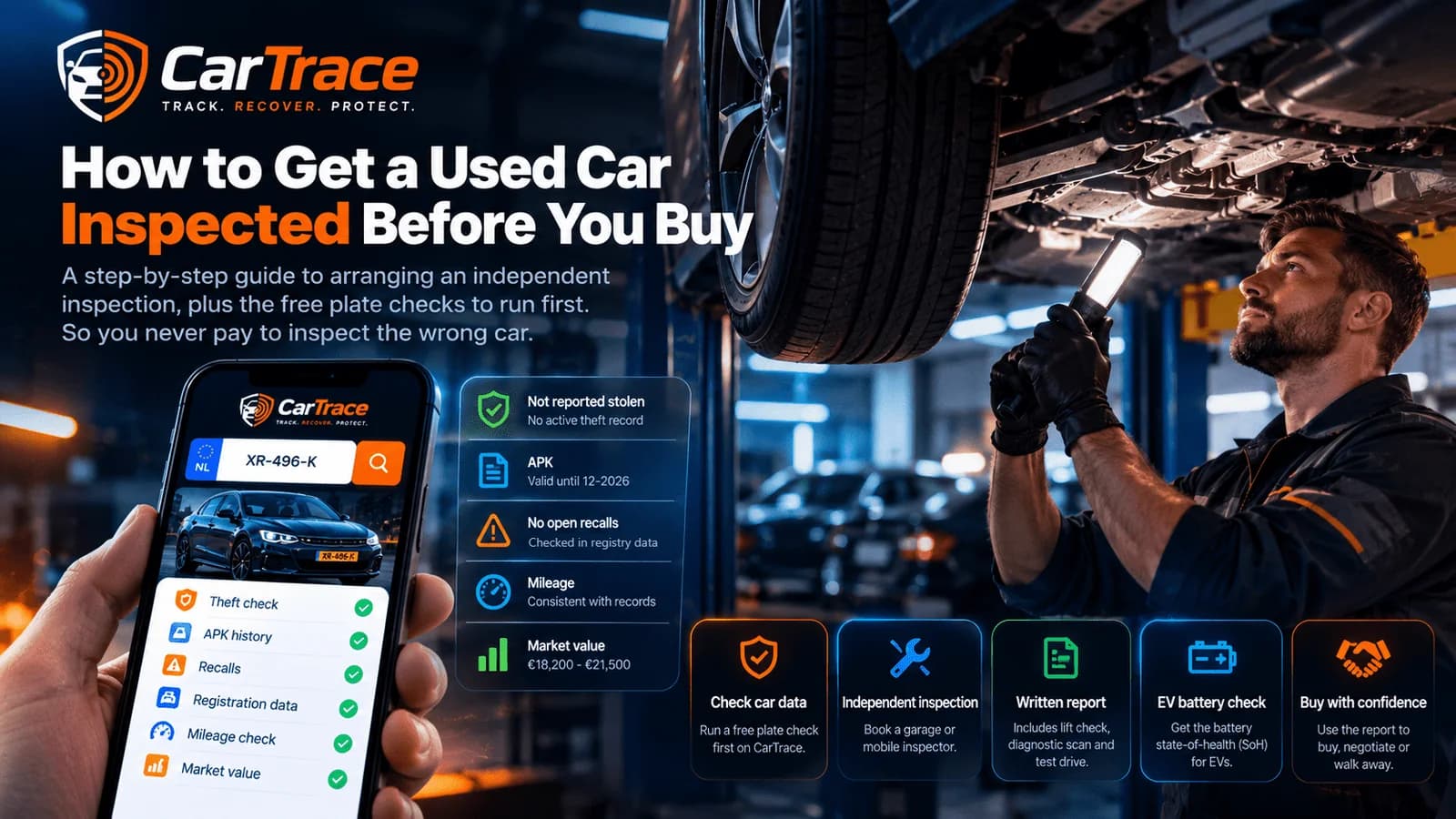
Quick answer: run a free plate check first, so you never pay to inspect a car registered as stolen or with WOK status. Then choose an independent inspector yourself, never one the seller suggests. Expect 150 to 350 euros and 45 minutes to two hours. And if the seller refuses an inspection, that tells you enough.
A used car almost always looks better on a sunny afternoon than it really is. The paint shines, the engine idles quietly, and the seller is friendly. An inspection takes the emotion out of it: someone with a lift, a diagnostic computer and no stake in the sale tells you what is actually wrong with the car, and what it will cost.
This guide is about the inspection itself, known in the Netherlands as an aankoopkeuring: when to get one, what it costs, who does it, what should be checked and what to do with the result. For the rest of the purchase, from advert to registration, see our used car checklist.
Free first, paid second: the order that saves money
An inspection costs a few hundred euros. A plate check costs a few minutes. Do them in that order. An inspector looks at the car, but not at what the register knows about it, and that is where the most expensive mistakes show up:
- Theft status. If the car is registered as stolen, you stop. No inspection, no offer.
- WOK status. WOK stands for "wachten op keuren" (awaiting inspection): after serious damage or a technical modification, the RDW (the Dutch vehicle authority) has to approve the car again.
- Odometer judgement. How the registered mileage readings relate to each other. An inspector sees what the odometer says today, not what it said five years ago.
- Recalls. Have the seller carry out an open recall before handover.
- Import history. If the first registration and the first Dutch registration differ, the car was imported and Dutch history is missing.
If a car fails here, you don't need the inspection and you still have the money. If it passes, you know what to ask the inspector to look at.
Enter the plate from the advert and see theft status, WOK, the odometer judgement, recalls and a value estimate in one overview, before you book an inspection.
Free plate checkWhat an inspection is, and what it isn't
A pre-purchase inspection (also called an occasionkeuring) is a technical inspection of one specific car, before you buy it, by someone you choose. The result is a report listing the faults found and, from a good inspector, an estimate of the repair costs.
It is not the same as the two checks buyers confuse it with:
- A fresh APK is not an inspection. The APK (the Dutch roadworthiness test) checks whether the car meets the legal minimum for safety and emissions on that day. A wearing clutch, a sweating turbo or a tired automatic gearbox passes it without comment.
- The seller's own check is not independent. A dealer's "150-point check" may be fine, but it was done by the party that wants to sell the car. Treat it as extra information, not as a replacement.
What does a pre-purchase inspection cost?
According to the ANWB, the Dutch motoring association, an inspection of an ordinary car costs between 150 and 350 euros. The difference is mostly in how much gets checked: one inspection covers far more points than another. What sets the price:
- Depth. A visual check with a test drive is cheaper than a lift inspection with fault-code readout, paint-thickness measurement and a written report.
- Type of car. Premium brands, performance models, hybrids and electric cars take more time and cost more.
- Location. An inspector who travels to the seller charges for it; driving to a garage yourself is usually cheaper.
- Extras. A battery test for an electric car, a longer test drive or a brand specialist come on top.
Whether you buy from a dealer or a private seller rarely changes the fee: it depends on the inspector, not the seller. The buyer usually pays. If the inspection finds faults, you can fairly include its cost in your negotiation.
Is it worth it? On a car costing a few thousand euros, almost always. One hidden gearbox fault or a worn-out battery costs many times the inspection fee.
Who inspects: garage, specialist or mobile inspector
The most important rule: you choose the inspector, not the seller. A garage the seller recommends knows the seller. Your options:
- Your own garage. Knows you, has no stake in the sale and often has a lift free. The car does have to get there.
- A brand specialist. Worth it for premium brands and electric cars: they know the model's weak spots and have the right diagnostic equipment.
- An inspection company. Organisations such as DEKRA inspect on location or at their own stations, with a fixed report format. If you are an ANWB member, ask whether a member discount applies.
- A mobile inspector. Comes to the seller. Useful when the car is far away or the seller won't drive, but without a lift you see less of the underside.
Not sure what deserves extra attention on your model, such as a known timing chain issue or a sensitive automatic gearbox? Ask Leo, our car advisor, with the plate number, and hand that list to the inspector.
What the inspector should check
Agree beforehand what the inspection includes. A good one covers at least this:
- Engine: leaks, cold start, smoke, noises, oil and coolant, and fault codes read through the OBD port.
- Gearbox and clutch: smooth shifting, no slipping, the bite point, and for an automatic, behaviour both cold and warm.
- Underside: rust at welds and suspension mounts, structural damage, exhaust, leaks, fresh underseal covering something up.
- Suspension and steering: bushes, shock absorbers, play in the steering.
- Brakes: pads, discs, fluid, handbrake.
- Tyres: tread, uneven wear (a sign of alignment problems or damage) and age from the DOT code.
- Body and paint: panel gaps, paint thickness, signs of accident repair.
- Electrics: lights, windows, air conditioning, infotainment, warning lights.
- Test drive: from a cold start, at motorway speed and with a firm brake test.
For an electric car or hybrid
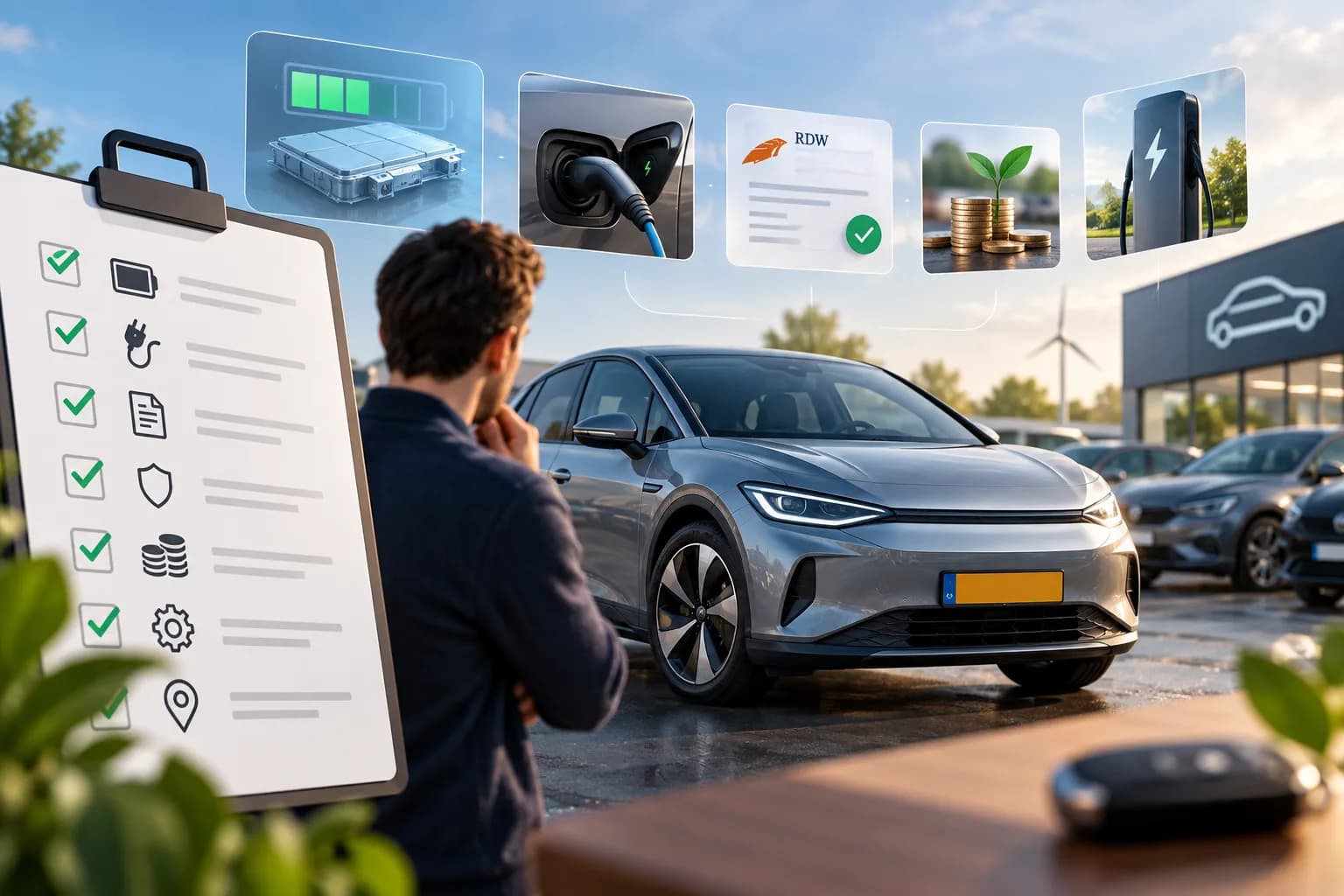
The traction battery is the most expensive part of an electric car, and a standard inspection does not measure it. Ask for a battery test with the state of health (SoH), or ask the seller for a recent battery certificate. The CarTrace plate check estimates the SoH you can expect for this car and reads in a certificate, so you can see whether the stated figure fits its age and use. More in our guide to buying a used electric car.
Private seller or dealer: why it matters
Buy from a car dealer and it is a consumer sale, with the protection that comes with it. Buy from a private individual and that extra protection does not apply, and your duty to investigate weighs more heavily: what you could have found with a reasonable check is hard to claim afterwards. That makes an inspection worth more in a private sale, not less.
With a private seller, check the seller as well as the car:
- Does the name on the registration card match the seller's ID?
- Do they have the tenaamstellingscode, the code needed to transfer the car to you?
- Does the address add up? A meeting in a car park or at the roadside is a warning sign.
- Do the make, model, colour and first registration from the plate check match the car in front of you?
How to arrange the inspection, in six steps
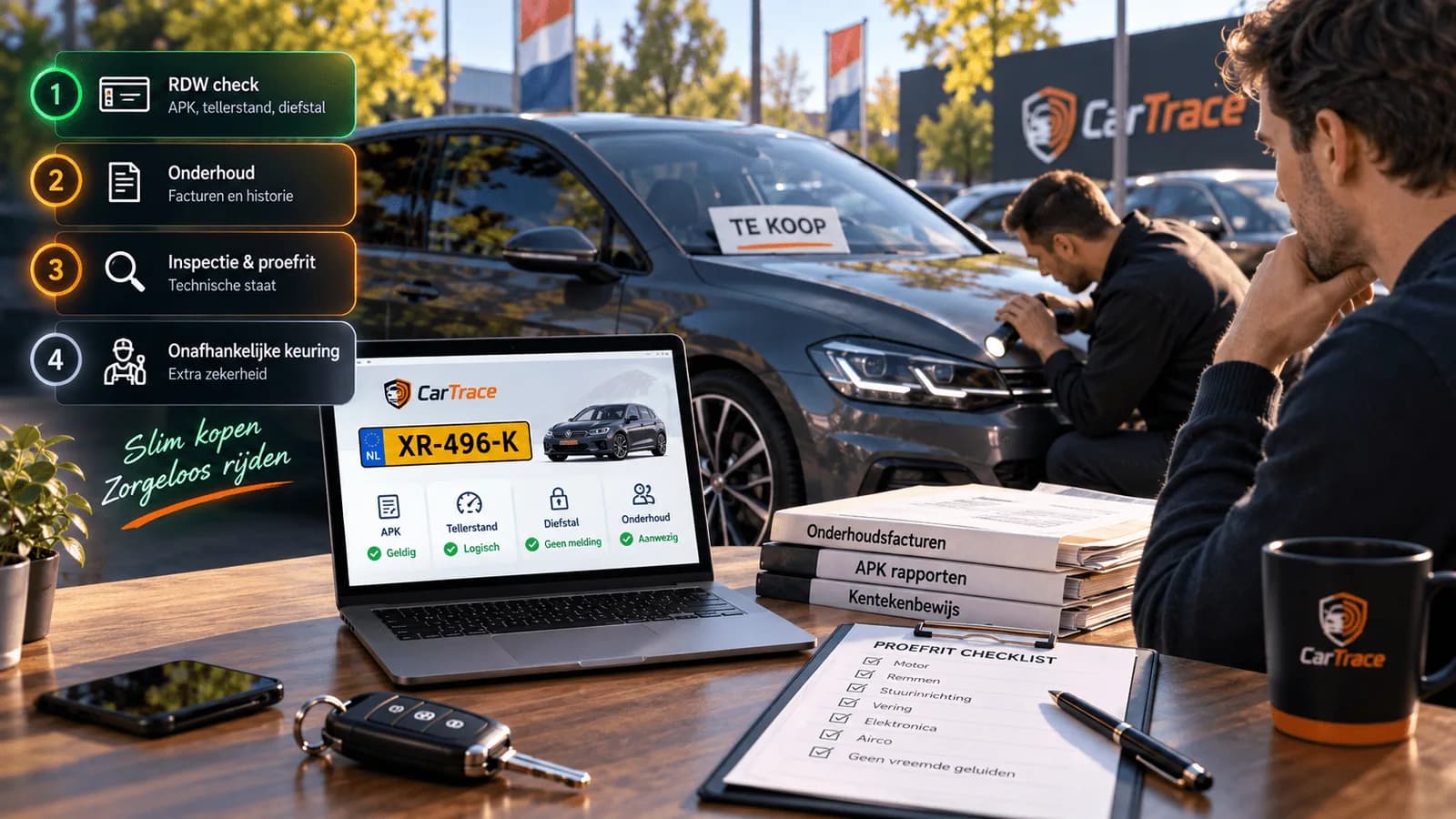
- Plate check. Theft status, WOK, odometer and recalls. If the car fails, stop here.
- Choose the inspector. A garage, brand specialist, inspection company or mobile inspector. Your choice.
- Agree it with the seller. Time, place, and ask for the car to arrive cold: a warm engine hides starting problems and smoke.
- Agree the scope. Lift, fault-code readout, test drive, battery test for an EV, and a written report with repair costs.
- Be there, or arrange a call with the inspector. Ten minutes in person teaches you more than three pages of report.
- Report first, money second. Pay nothing and sign nothing until you have the result.
The message to the seller can be simple:
"Hi, I'm seriously interested in the car. Before I decide, I'd like an independent inspection at [garage] on [day and time]. I'll cover the cost. Could the car arrive cold, please?"
How long does an inspection take?
Allow 45 minutes to a little over two hours. A visual check with a test drive is at the short end; a lift inspection with diagnostics, a battery test and a written report at the long end. A proper test drive alone takes twenty to thirty minutes. You usually get the verbal result straight away, the written report sometimes later that day. Tell the seller beforehand how long it will take.
Can you buy a car without an inspection?
You can, but only if you could absorb the biggest repair that might come. Skipping it is a reasonable risk for:
- a cheap car you could repair or replace without pain;
- a car from a dealer you trust, with a real warranty;
- a car from family or friends with a full service history.
Do not skip it on expensive cars, electric cars and hybrids, private sales, imports with little history, or models with a known weak engine or gearbox. And whatever you decide, never skip the free plate check. It catches the most expensive mistakes in a few minutes.
Seller refuses an inspection? Ask why. "It's not necessary" or "someone else is coming this afternoon" is pressure, not a reason. A seller with nothing to hide lets someone look.
The report: buy, negotiate or walk away
An inspection report is more than a score. Sort it into three piles:
- Normal wear for the age and mileage: tyres, brake pads, a wiper blade. Part of buying used and no reason to back out.
- Faults with a price: a leaking oil seal, worn shock absorbers, overdue servicing. This is your negotiating room, with a number behind it. Ask for the repair before handover or for a lower price.
- Deal-breakers: structural damage, rust in load-bearing parts, serious gearbox problems, a battery well below its expected SoH, or an identity that doesn't add up. You don't negotiate here, you walk away.
Negotiate on facts, not feelings: "the report says new shock absorbers at about 600 euros, so I'm offering that much less" works better than "can you do a bit better?". And if you buy the car, add it to My Garage straight away, so the APK, recalls and servicing are tracked from day one.
Prices are indicative and based on the ANWB, anwb.nl/auto/kopen/aankoopkeuring (October 2026); always ask the inspector for a quote. The legal points are simplified and are not legal advice.
Frequently asked questions
›How much does a pre-purchase car inspection cost in the Netherlands?
Usually between 150 and 350 euros for an ordinary car, depending on the provider and how much is checked. An inspector on location, a premium brand or a battery test on an electric car makes it more expensive.
›How long does a pre-purchase inspection take?
Usually 45 minutes to a little over two hours, including the test drive. A full inspection with diagnostics, a battery test and a written report is at the long end.
›Is a fresh APK the same as an inspection?
No. The APK only checks the legal minimum for safety and emissions. Wear on the clutch, gearbox or turbo falls outside it. A pre-purchase inspection looks at the technical condition and the costs to expect.
›Can I get a car from a private seller inspected?
Yes, and it is the smart thing to do: a private sale gives you less protection and your own duty to investigate weighs more heavily. Most private sellers agree if you ask politely, pay the cost and make it easy.
›What if the seller won't allow an inspection?
Ask why. If there is no good reason, walk away. Urgency or "someone else is coming to look" is pressure, not an argument.
›Should I do the inspection or the plate check first?
The plate check. It is free and filters out stolen cars, cars with WOK status, illogical odometer readings and open recalls, so you only pay to inspect cars that pass that first test.
This article was drafted with the help of AI tools, including Leo, and checked and edited by the CarTrace team before publication.
Check any VIN or licence plate for free.
See more of CarTrace on Google
Pick CarTrace as a preferred source and our guides show up more often in your Top Stories and AI answers on Google.
Add CarTrace as a preferred source on Google