Low-emission zones in the Netherlands: can your car still enter? (2026)
· 8 min read ·
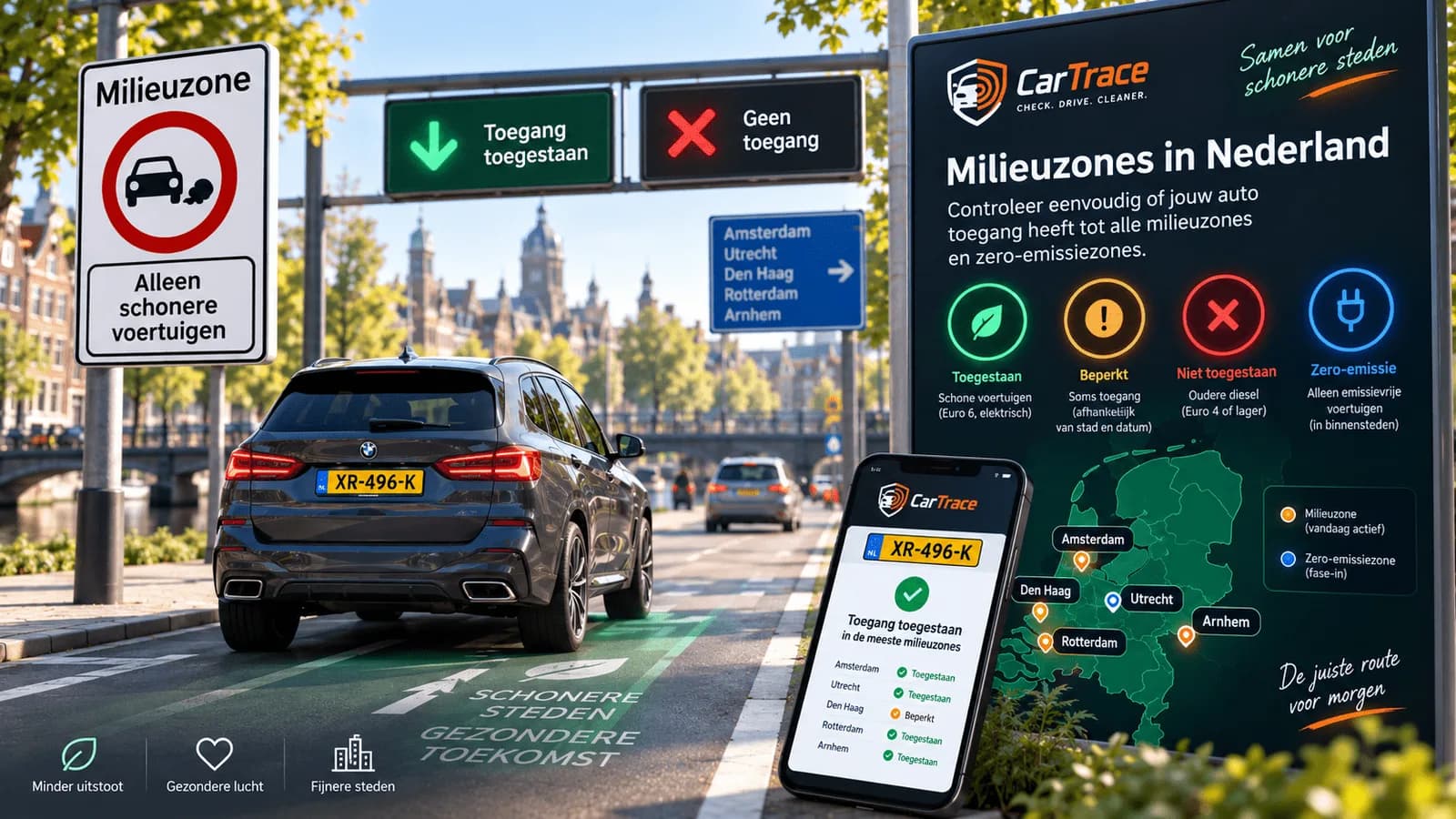
Most people searching for the Dutch milieuzone want one answer: am I allowed in or not. The short version is less alarming than the debate suggests. A milieuzone is a diesel rule. If you drive petrol, LPG, hybrid, electric or hydrogen, you may enter every Dutch low-emission zone, whatever the model year.
If you drive diesel, it depends on your emission class and on the city. That is where the confusion starts: zones differ by municipality and by vehicle type, and since 1 January 2026 the sign says something different from the sign that stood there for years. This guide sets out the rules as they stand today.
Where the zones are, and who they apply to
"Four cities" is the figure everyone repeats, and it is only true for diesel passenger cars. For other vehicle types the map looks very different:
- Diesel cars and vans: Amsterdam, Arnhem, The Hague and Utrecht. Since 1 June 2026 Arnhem also has a zero-emission zone for vans and trucks, on top of its milieuzone for diesel cars.
- Diesel trucks: Amsterdam, Breda, Delft, Maastricht, Rijswijk and the Maasvlakte in Rotterdam, among others.
- Buses: Amsterdam, Arnhem, The Hague, Eindhoven, Rijswijk and Utrecht, among others.
- Mopeds and light mopeds: Amsterdam, The Hague and, since 1 January 2025, Nijmegen.
One city can therefore run a milieuzone for cars, a stricter zone for freight and a zero-emission zone at the same time, with different boundaries on the map. The edge of one zone is not the edge of the other.
The new sign since 1 January 2026
Since 1 January 2026 both milieuzones and zero-emission zones are marked with a single new traffic sign. Municipalities were given the first six months of 2026 to swap the old signs out, so you may still meet both.
The important change is not the shape but the reading. The new sign names the emission class that is refused, where the old sign named the classes that were allowed. Read the new sign with the old habit and you conclude the exact opposite of what it says.
Alongside that, municipalities use three colours to signal how strict a zone is:
- Green: diesel cars and vans from emission class 4 upwards may enter. Classes 0 to 3 may not.
- Blue: stricter. Diesel from emission class 5 upwards may enter.
- Purple: applies to diesel trucks. Only emission class 6 may enter.
Your emission class is not printed on the Dutch kentekencard (registration card), but it is in the RDW's public vehicle data. If you do not know it by heart, look it up before you drive into a zone.
Zero-emission zones: the rule that hits businesses
A zero-emission zone is not the same thing as a milieuzone, and confusing the two costs business owners money. Zero-emission zones apply to vans and trucks, not to passenger cars. The first eighteen municipalities and Schiphol introduced one on 1 January 2025, and the number is growing.
In the end state only vehicles with no tailpipe emissions get in. Until then a national transition scheme applies, and these are the dates that belong in your calendar:
- Emission class 4 and below: no access, already today.
- Class 5 vans: access up to and including 31 December 2026.
- Class 6 vans first registered before 1 January 2025: access up to and including 31 December 2027.
- After that: electric and hydrogen only, exemptions aside.
There is a proposal to extend that transition by a year, but at the time of writing it has not been adopted. Plan against the dates that apply now, not the ones being hoped for.
How to check whether your vehicle is allowed in
There are two official checks and they answer different questions. The RVO milieuzone check covers the classic low-emission zones. The check on the national zero-emission zone site covers vans and trucks, including how the transition scheme applies to your specific plate. Both are free and work on a registration number.
What neither tells you is the condition of the car you are about to buy. For that you pull the rest of the file: emission class, fuel, date of first admission, APK (the Dutch roadworthiness test) status and odometer judgement all sit in the same RDW record. Our guide to the RDW plate check explains how to read it.
Enter a Dutch plate and see fuel, emission class, date of first admission, APK status, odometer judgement, recalls and theft status in one view. Free, no account.
Free plate checkOnly the municipality itself can grant an exemption. Anyone selling "guaranteed access" to a low-emission zone is selling something they cannot deliver.
Blanket exemption or individual permit?
A vrijstelling is a blanket exemption: it applies automatically to a whole category, with nothing to apply for. An ontheffing is an individual permit you request for your own situation, and the municipality decides.
Most zones exempt vehicles of 40 years and older, counted from the date of first admission, as well as emergency services and wheelchair-accessible vehicles. Note that not every municipality uses the same classic-car rule, so check it city by city rather than assuming it nationally.
An individual permit exists for the cases no category covers: a house move, a business that demonstrably has to be inside the zone, abnormal transport. Allow several weeks for processing, which means not applying in the week you need it.
Enforcement and fines
Cities enforce with plate-reading cameras at the access roads. There is no barrier and nobody pulls you over: the detection is automatic and the fine arrives by post.
For a passenger car it is €130 plus €9 in administrative costs. For a truck it is around €310. Drive into the zone on several days and you collect a fine for each detection, which adds up quickly.
If a fine is wrong, because you held a valid permit or because the car had already been sold on the date of the detection, object within the deadline printed on the notice and attach your evidence.
What this means if you are buying a car now
Zone policy gets stricter, not looser. That makes the emission class of a used diesel a price factor rather than a detail: a car that will not be allowed into the city you live in two years from now also sells badly two years from now.
- Mostly city driving? Check the emission class before you go and look, not after.
- Running a mixed fleet? Put the replacement dates for your class 5 and class 6 vans in the plan now.
- Torn between buying and something else? Run both through our buying versus private lease comparison.
- Buying that diesel anyway? Work through the rest of the file with our guide to checking a used car.
The question is not whether your car may enter the zone today, but whether it may still enter three years from now. That is the difference between a good buy and an expensive one.
Sources: Milieuzones.nl, Ondernemersplein (Dutch government), Op weg naar ZES and the RVO low-emission zone check. Rules and zone boundaries change per municipality. Last checked on 12 September 2026.
Frequently asked questions
›Which cars are refused entry to a Dutch low-emission zone?
Only diesel vehicles are refused, and which ones depends on the sign. A green zone refuses diesel cars and vans of emission class 0 to 3, a blue zone also refuses class 4, and a purple zone admits only diesel trucks of emission class 6.
›Does a milieuzone apply to petrol cars as well?
No. Vehicles running on anything other than diesel may enter every Dutch low-emission zone, including older petrol cars. Electric and hydrogen vehicles may also enter the zero-emission zones.
›What does a low-emission zone fine cost?
For a passenger car it is €130 plus €9 in administrative costs; for a truck it is around €310. You are fined per detection, so entering the zone on several consecutive days produces several fines.
›Can I drive my classic car into a low-emission zone?
Most zones exempt vehicles of 40 years and older automatically, counted from the date of first admission in the RDW register. Not every municipality applies the same rule, so check the exemption for that specific city before you set off.
›What is the difference between a milieuzone and a zero-emission zone?
A milieuzone refuses older diesel vehicles by emission class and, in a handful of cities, applies to passenger cars too. A zero-emission zone applies to vans and trucks and will eventually admit only vehicles with no tailpipe emissions, with a transition running to the end of 2026 for class 5 and the end of 2027 for class 6.
Check any VIN or licence plate for free.