Engine, Brakes, Battery and Tyres: How to Check a Used Car With a Mechanic and a Plate Check
· 11 min read
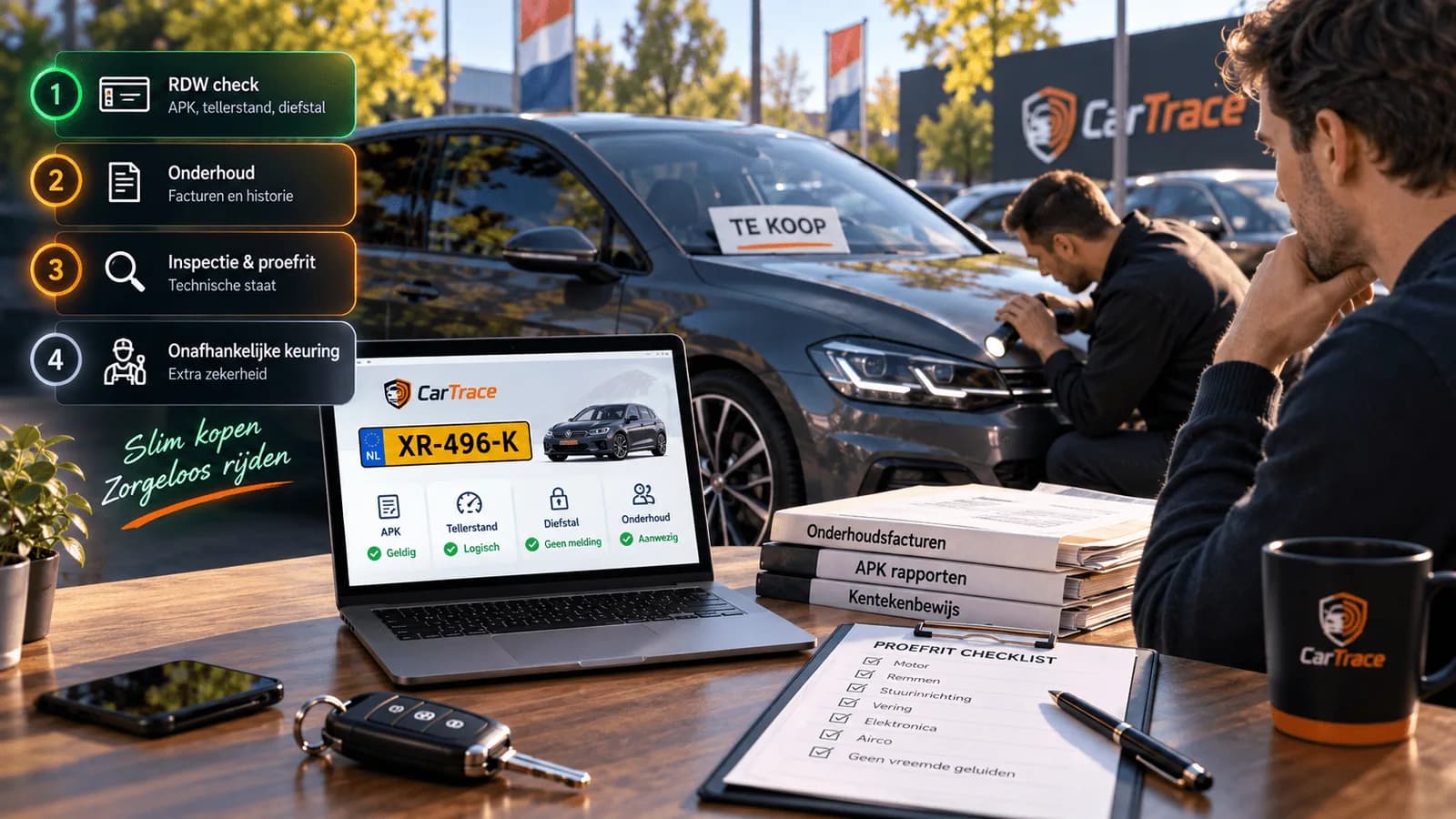
Buying a used car comes down to two questions. Is the car what the seller says it is? And is it mechanically sound? The first needs data: the plate, the register, the inspection record. The second needs eyes, ears and ideally a mechanic. Do only one of the two and you buy with a blind spot.
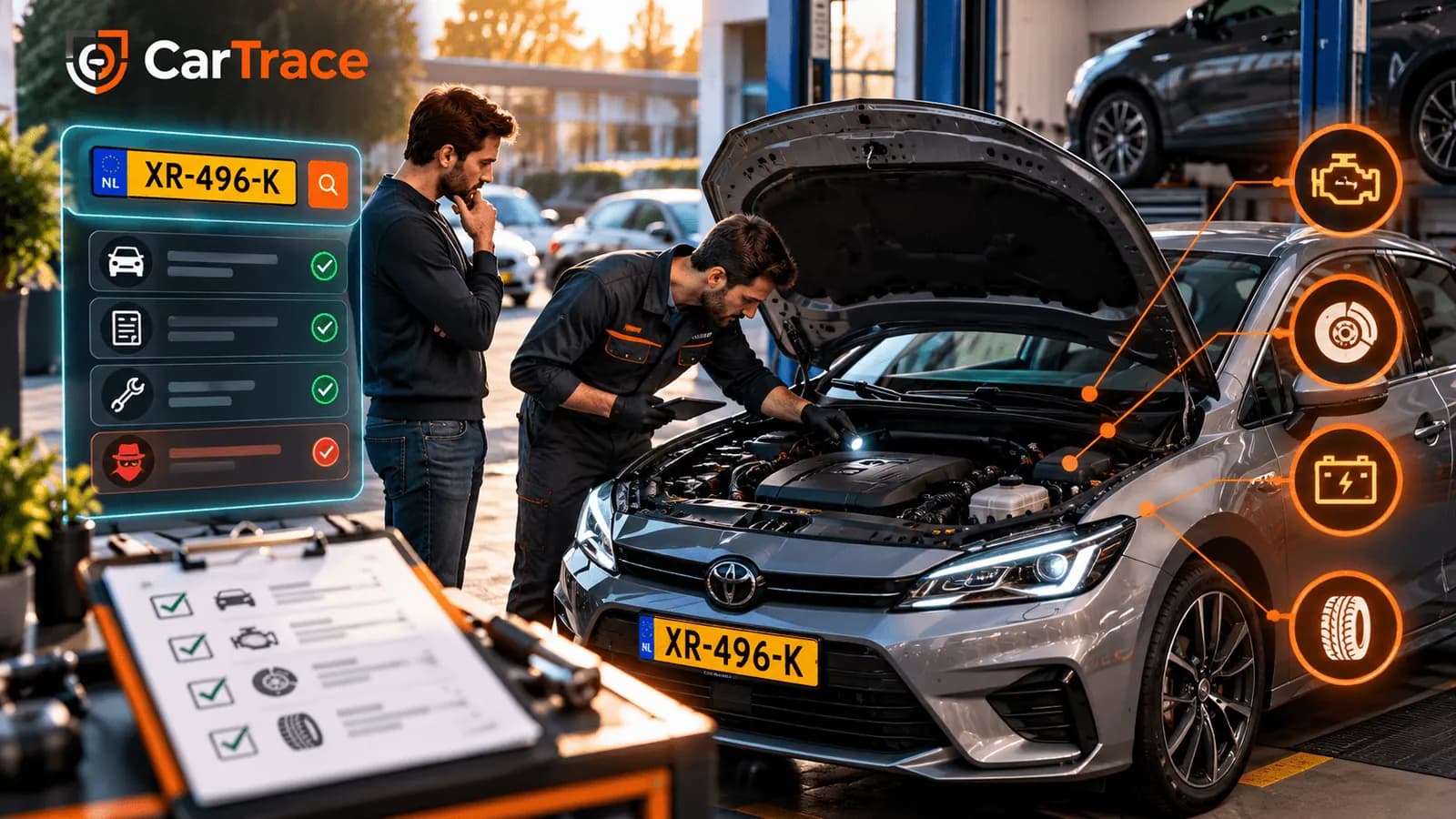
This guide walks through the four parts that most often cost money: engine, brakes, battery and tyres. For each one you'll read what you can see yourself, what a mechanic should measure and when it's better to walk away. Then you'll see how the plate check, Car Finder and Leo, CarTrace's AI assistant, fill the gaps a mechanic can't close. The guide describes the Dutch market.
Short answer: run a plate check first (stolen status, APK, odometer verdict, recalls). Then start the car from cold, watch for smoke and warning lights, brake hard on the test drive, have the battery tested (on an EV, its State of Health) and check tyre tread and age. If you have doubts about the engine or gearbox, have a mechanic look before you pay.
Two checks, one decision: data and mechanics
A mechanic can hear a bearing that hums, but can't see that the car is registered as stolen. A plate check sees that, but can't hear a bearing. The two complement each other:
- What only the data shows: whether the car has been reported stolen, whether the register matches the car and the advert, when the APK (the Dutch roadworthiness test) expires, RDW's odometer verdict, a WOK status after serious damage and open recalls.
- What only a mechanic shows: leaks, wear, rust underneath, fault codes, the condition of brakes, suspension and gearbox, and how the car drives.
- Where they meet: an APK defect in the inspection history tells the mechanic where to look harder. An odometer the RDW calls illogical suddenly makes wear on the steering wheel and seat important evidence.
Step 1: the plate check, before you drive anywhere
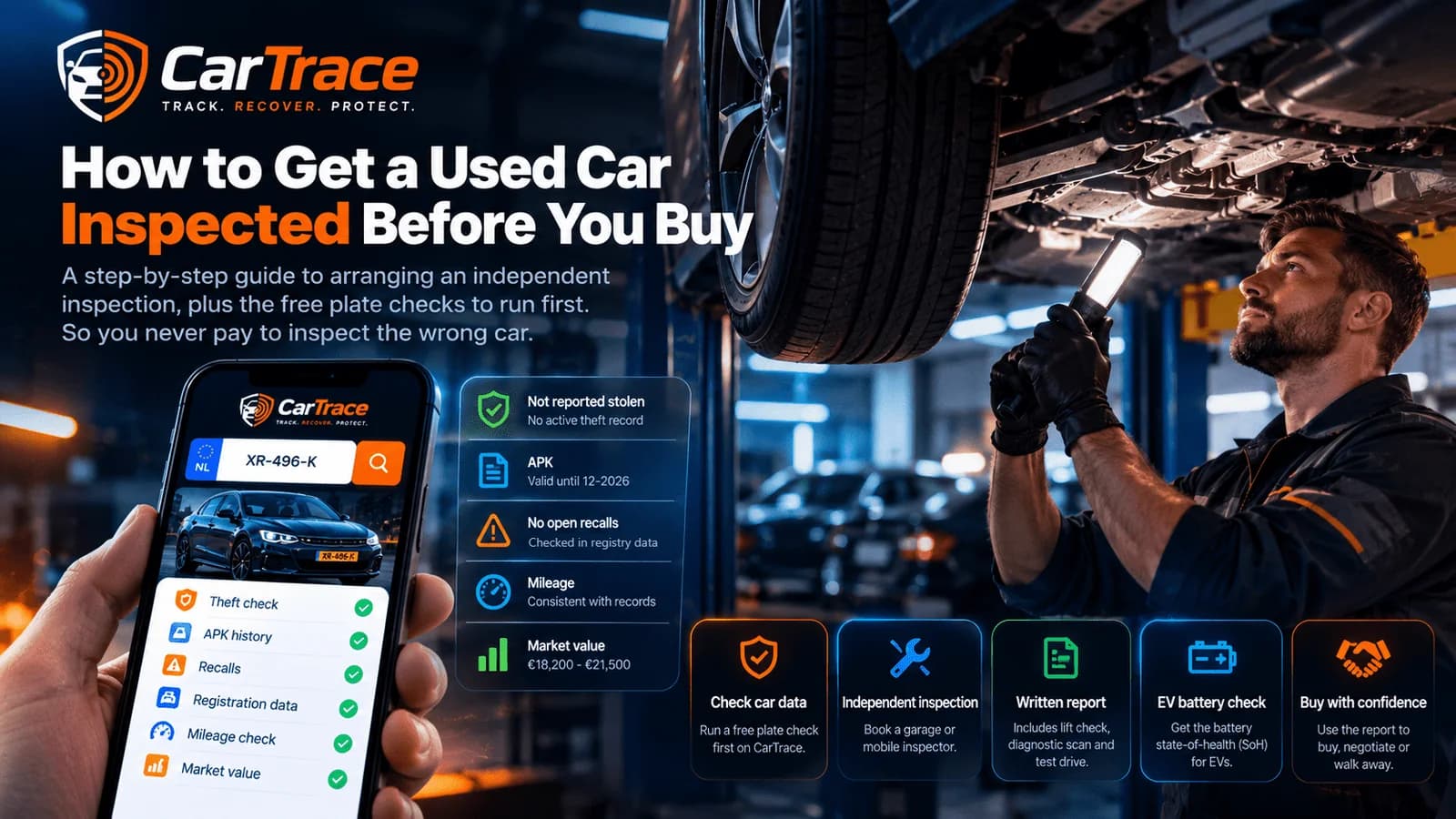
The cheapest check comes first. Enter the plate and within seconds you know whether the trip to the seller is worth it. The CarTrace plate check pulls data from the RDW register and combines it with a stolen check:
- Vehicle data: make, model, colour, fuel, date of first registration and first registration in the Netherlands. If it doesn't match the car or the advert, stop here.
- Documents and status: the APK expiry date, the odometer verdict and any WOK status (awaiting inspection, after serious damage).
- Inspection history: the defects found at earlier APK tests. Brakes or tyres again and again tell you how the car has been maintained.
- Stolen and recalled: whether the car is known as stolen, and whether a recall is open for this car. A recall is free to fix at a dealer, but something to sort out before you buy.
Check the plate before you book a viewing. It takes seconds and filters out the cars you don't want to see.
Check a plateEngine: cold start, smoke and the warning light
The cold start
Ask the seller not to start the car beforehand, and feel the bonnet when you arrive. A warm engine can hide a poor cold start, a ticking engine or starting problems. When it starts, notice how quickly it fires, whether the idle settles and whether you hear ticking, rattling or squealing.
What the smoke colour tells you
- Thin white vapour on a cold morning: condensation, normal. It disappears once the engine is warm.
- Thick white smoke that lingers, with a sweet smell: possibly coolant in the combustion. Think of a leaking head gasket. Walk away or have it investigated.
- Blue smoke: the engine is burning oil, for example from worn piston rings, valve stem seals or a turbo. Expensive.
- Black smoke: too much fuel. A little is normal on an older diesel at full throttle, but not at idle or on a petrol engine.
The engine warning light and the OBD scanner
If the engine warning light is on, don't buy the car until you know why. It could be a loose sensor, but also a catalytic converter or an injector. Petrol cars from 2001 and diesels from 2004 have an OBD port, usually under the dashboard. A simple scanner costs around twenty euros and reads the stored fault codes. A lit warning light can also be a reason to fail the APK.
Watch for the opposite too: a light that doesn't come on at all at start-up may have been disconnected. And fault codes can be cleared just before a viewing. A scanner shows through the so-called readiness monitors whether the car has completed its self-tests. If many read 'not ready', the codes were probably cleared recently.
Oil, coolant and the timing belt
- Oil level and colour: too low is a bad sign about maintenance. Pitch black and thick means a missed service.
- White residue under the oil filler cap: can be condensation from lots of short trips. Together with coolant loss and white smoke it's a warning.
- Coolant: at the right level and the right colour, with no oil in it.
- Timing belt: manufacturers specify replacement after a number of years or kilometres. Ask for the invoice. A snapped belt can wreck an engine.
Brakes: what you hear, feel and see
- Squealing: a wear indicator or glazed pads.
- Grinding or scraping: pads worn down to the metal. Replace immediately.
- Pulsing pedal or steering wheel: warped or unevenly worn discs.
- Car pulls to one side: a sticking caliper or uneven wear.
- Soft or long pedal: air in the system or old brake fluid.
Also look through the wheel at the brake disc. A clear lip on the outer edge means the disc is well worn. The minimum thickness is often stamped on the disc itself (MIN TH). Brake fluid absorbs moisture; many manufacturers specify replacing it every two years. If that's not in the service history, factor it in.
Brakes are relatively cheap to repair. But neglected brakes often say something about how the whole car has been maintained. On an electric car or hybrid the pads wear less, because the motor does much of the braking. There, rust on discs that are used too little is a known issue instead.
Battery: the 12-volt and an EV's battery pack
The 12-volt battery
- Age: the label carries a date code. A 12-volt battery often lasts four to six years, depending on use and climate.
- Test: a garage measures its condition in a few minutes. Slow starts and a stop-start system that has stopped working are early signs.
- Stop-start: cars with stop-start use an AGM or EFB battery. It costs more, and with many brands a new battery has to be registered in the car's system.
- In an EV too: an electric car has a 12-volt battery as well as the big pack. A weak 12-volt battery is a known cause of an EV that won't wake up.
An electric car's battery pack
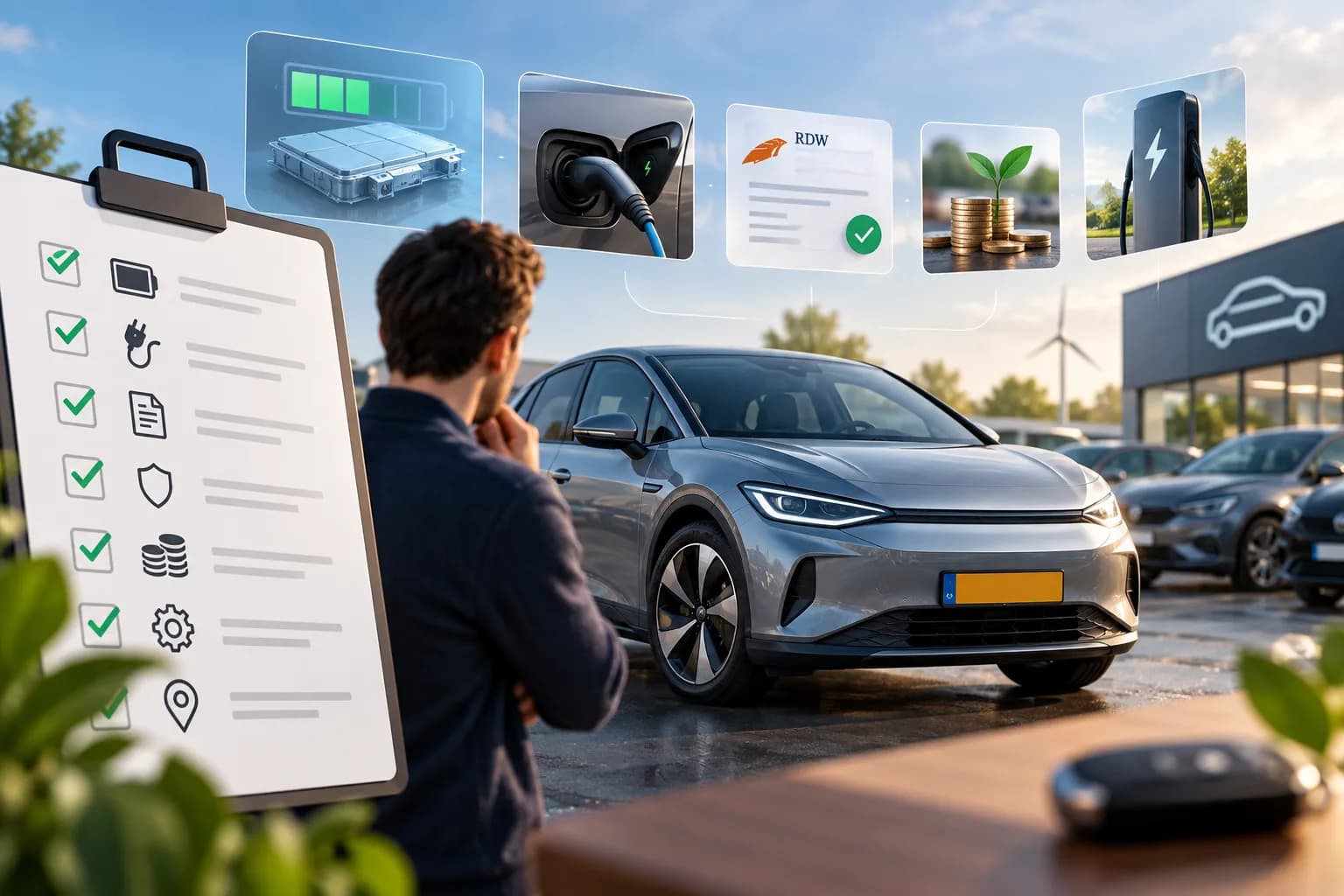
On an EV, the battery pack is the most expensive part and drives much of the car's value. The key measure is the State of Health (SoH): how much capacity is left compared with new. Ask for a battery test or certificate, compare the range with the original figure and check the battery warranty. It often runs 8 years or 160,000 kilometres, with a threshold that is often around 70 percent. Terms differ by brand.
CarTrace helps with battery health: for a specific electric car we estimate the SoH you can expect for its age and use. If the seller has a battery certificate, you can read it in. The figures are extracted from the document with fixed rules, not interpreted by an AI, and anything unclear is left for you to confirm. That way you can see whether the measured figure fits what you should expect for this car. Read more about charging and wear in is fast charging bad for your battery? and in our guide to buying a used electric car.
Tyres: tread, wear pattern and age
- Tread depth: the legal minimum in the Netherlands is 1.6 millimetres, which is also the APK limit. Tyre specialists advise replacing sooner, because stopping distances on wet roads grow quickly with less tread.
- Inner or outer edge more worn: the alignment is off, or there's a problem with the suspension or from a collision.
- Both edges worn: tyre pressure too low. Only the centre: pressure too high.
- Wavy, cupped wear: often worn shock absorbers.
- Different brands on one axle: not illegal, but a sign of cutting corners.
Check the age too. The sidewall carries a DOT code, and its last four digits are the week and year of production: 2321 means week 23 of 2021. Rubber ages even when a tyre isn't driven much. Cracks in the sidewall are a reason to replace, however much tread is left. Electric cars are heavier and deliver torque instantly, so their tyres can wear faster.
What will this car cost you? Value, monthly cost and CO2
After the inspection you have a list of work. The question then isn't only 'what does the repair cost?' but also 'what is this car worth, and what does it cost per month?'. All of that is in the CarTrace report for the same plate:
- Market value: an estimate based on comparable cars for sale right now, with the same powertrain. Subtract the repairs and you have an offer you can back up.
- Monthly cost: what the car costs per month, including Dutch road tax (MRB).
- CO2 footprint: how much CO2 the car emits in real use, calculated with the official Dutch emission factors. Read about the gap with the test-bench figure in your car's CO2 emissions.
- Low-emission zones: whether the car may enter the environmental zones in Dutch cities. Useful for an older diesel. See low-emission zones in the Netherlands.
- Compare: torn between two or three cars? Put them side by side with compare plates.
Still choosing between models? Car Finder and Leo
Sometimes the question isn't 'is this car good?' but 'which car should I actually buy?'. That's what Car Finder is for. Pick up to five models you're considering, or just enter what you want, such as budget, fuel and gearbox. Car Finder searches live adverts, rates the models and the adverts and shows which fit your wishes best.
Want to dig deeper? Ask Leo, CarTrace's AI assistant. Ask Leo about known weak points of an engine or gearbox, so your mechanic knows where to look. Or ask whether an asking price fits comparable adverts. Leo shows where its figures come from. Leo is an AI and can make mistakes, so check anything that matters to your decision.
Not sure which car it'll be? Compare models on live adverts and let Leo help you decide.
Open Car FinderDecision guide: buy, negotiate or walk away
- Buy or negotiate: worn tyres, brake pads and discs, an old 12-volt battery, a missed service. Get a quote and deduct it from the price.
- Only with a firm quote: shock absorbers, alignment, a leaking gasket, a timing belt that's due.
- Walk away: blue or lingering white smoke, a slipping gearbox, a warning light nobody can explain, an EV battery well below the expected SoH, structural rust.
- Always walk away: a stolen report, a plate or VIN that doesn't match the documents, or an illogical odometer without a written explanation.
After you buy: keep track in My Garage
Bought it? Add the car to My Garage. We track the APK expiry date and email you before it runs out, show open recalls, keep the estimated value up to date and show CO2 emissions per month. That way you start with your new car the way you bought it: with all its data in one place. More in My Garage.
Add your car by plate and never miss an APK or a recall again.
Go to My GarageThis guide is general information, not technical or legal advice, and does not replace an inspection by a mechanic. Sources: RDW (APK requirements and open data), Directive 98/69/EC (EOBD), manufacturers' warranty terms. Also read pre-purchase inspection and checking a used car. Last checked: 12 October 2026.
Frequently asked questions
›Can I buy a car with the engine warning light on?
Not until you know why it's on. Have the fault codes read with an OBD scanner, get a repair quote and deduct it from the price. If the cause is unclear or major, such as the catalytic converter, you're better off walking away.
›What is the minimum tyre tread depth?
In the Netherlands the legal minimum is 1.6 millimetres, and it's checked at the APK. Tyre specialists advise replacing sooner, because stopping distances on wet roads grow quickly with less tread.
›How can I tell how old the tyres are?
From the DOT code on the sidewall. The last four digits are the week and year of production: 2321 means week 23 of 2021. Cracks in the sidewall are a reason to replace, even with enough tread left.
›How do I check the battery of a used electric car?
Ask for a battery test or certificate with the State of Health (SoH), compare the range with the original figure and check the remaining battery warranty. CarTrace shows the SoH you can expect for that car and lets you read in a certificate to see whether the measured figure fits.
›Does a plate check show whether the engine is good?
No. A plate check shows whether the car is stolen, whether its data adds up, when the APK expires, the odometer verdict and recalls. Only a mechanic sees the condition of the engine, brakes and gearbox. So do both, and the plate check first.
›I don't know which car I want yet. Where do I start?
With Car Finder. Pick up to five models or just enter what you want, such as budget, fuel and gearbox, and Car Finder compares them on live adverts. Leo, CarTrace's AI assistant, then helps you choose and tells you what to look for at the viewing.
This article was drafted with the help of AI tools, including Leo, and checked and edited by the CarTrace team before publication.
Check any VIN or licence plate for free.
See more of CarTrace on Google
Pick CarTrace as a preferred source and our guides show up more often in your Top Stories and AI answers on Google.
Add CarTrace as a preferred source on Google